• Book Online
(780) 455-2112 | info@ocwc.ca
Oliver Chiropractic Wellness Clinic
  • Why OCWC
    • About Us
    • Our Team
    • Client Reviews
  • Services
    • Chiropractic
    • Massage
    • Manual Lymphatic Drainage
    • Acupuncture (General)
    • Acupuncture (Facial)
    • Shockwave Therapy
    • Manual Osteopoathy
    • FAQ
  • New Patients
    • What to Expect
    • Forms
      • OCWC Cancelation/Financial Policy
  • Blog
  • Contact
    • General Inquiries
  • Book Online
  • Menu Menu
You are here: Home1 / Neck Pain

Posts

Ever Wonder: Why Does My Neck Hurt?

November 1, 2025/0 Comments/in Chiropractic Blog, Health /by Dr. Kent Ferguson

Why Does My Neck Hurt?

Why does my neck hurt? Your neck has a tough job. It has to hold, stabilize, and move the weight of your head every day for a lifetime. Holding up 11 pounds may not seem like a lot, but the seven bones and 20 muscles of your neck need to work together in perfect harmony for you to move your head around and keep that weight balanced. Postural changes, sudden injuries, and arthritis are a few of the primary causes of neck pain.

Pain can often be traced to a problem with either the muscles, bones, discs, or nerves in your neck.

Why it Matters:

If you’ve ever wondered why does my neck hurt? If you’ve ever been unable to turn your head for a day or two, you know how debilitating and life-changing neck pain can be. The sharp muscle spasms that restrict your ability to move can happen when your body tries to protect a spinal joint that isn’t moving correctly.

Almost every bone in your neck has a pair of sliding joints towards the back called facet joints. If an adhesion forms or the joint is stuck, your body will try to compensate or work around the issue for a little while. But, over time, this compensation can cause a cascade of additional challenges.

  • Sudden injuries, arthritis, and postural issues can all contribute to neck pain.
  • The small sliding joints (facet joints) of your neck can become stuck and cause muscles spasms and pain.
  • Gentle spinal adjustments combined with daily stretching can help restore the motion of your facet joints and reduce pain.

Pain in your neck is your body’s way of saying “pain attention”! Even if it eases up by the end of the day, it’s a smart idea to have us evaluate your motion. Movement assessments are a part of our examination and provide us with an incredible amount of information about your body. By taking a proactive approach today, you may be able to prevent future episodes of neck pain and stiffness in the future.

Stenosis: How a Pinch in Your Neck Can Affect Your Whole Body

Here’s a potential answer to question – why does my neck hurt? Have you been told that you have spinal stenosis? If so, you’re not alone. Millions of people suffer from spinal stenosis each day, and it’s the number one reason people over 65 years old have spine surgery. Spinal stenosis is the compression, or pinching, of your spinal cord. It can occur due to a disc herniation, bone spur, or ligament overgrowth. But, drugs and surgery are not the only way to find relief.

Why it Matters:

For many people, the most significant challenge associated with spinal stenosis is the decreased ability to get up and move! Severe pinching in your neck can cause issues with your arms and legs. One of the best ways to relieve the symptoms associated with spinal stenosis is to open up the spinal canal and take the pressure off the nerves and spinal cord. Many chiropractic techniques focus on decreasing the pressure on your spinal cord, relieving the symptoms associated with spinal stenosis.

  • Spinal stenosis is a narrowing of the spaces within your spine, which can put pressure on the nerves that travel through the spine.
  • Spinal stenosis is most commonly caused by degenerative changes in the spine related to osteoarthritis.
  • Relief can often be found by building up your strength while improving the flexibility and stability of your spine with chiropractic care.

After chiropractic care, many patients report having a decrease in their symptoms, the ability to walk further without pain and find an improvement in their overall quality of life. If you have been slowed down due to spinal stenosis, do not hesitate to schedule an evaluation with us. We will provide a complete evaluation and guide you towards the best treatment options to find relief.

Is My Arm Pain Coming from My Neck?

Pain in your hand, wrist, or arm can be frustrating. You don’t realize how much you use your arms and hands until pain, numbness, or tingling gets in the way. Most of us don’t usually think that an issue in our neck may cause our arm pain. But it’s very common that arm pain can be traced back to a nerve issue in your neck.

Why it Matters:

Hand, wrist, and arm pain often starts with a neck problem. When a spinal disc in your neck irritates or presses on a nerve, it can result in arm pain. Just like the power lines that bring electricity to your house, your brain and spinal cord split into individual nerve roots that deliver information to every part of your body. The nerves in your neck are specifically focused on providing strength and sensation to your head and arms.

  • A bulged or herniated disc in your neck can irritate or compress the nerves that travel to your hands, arms, and shoulders
  • A recent study of people with cervical (neck) disc herniation showed improvement in over 86% of people who received chiropractic adjustments.
  • Improving spinal mobility, decreasing inflammation, and improving your posture may help prevent future episodes of neck and arm pain.

A painful arm as a result of a pinched nerve in your neck very rarely requires surgery. Most people can find long-term relief with conservative care, such as chiropractic.

Getting rid of the inflammation and giving the disc time to heal are part of a complete plan we use each day to help our patients reduce their symptoms and get their lives back.

Neck Pain: How To Find Relief

An episode of neck pain can quickly hamper your everyday activities. The answer to the question – why does my neck hurt can be varied. Whether you began experiencing pain due to injury, degenerative spinal changes, or poor posture, it can be difficult to think about anything except the pain when you’re struggling. It’s estimated that 70% of people experience neck pain in their life, but you should know there is a path towards relief.

Why it Matters:

Neck pain can create everything from headaches to pain in your arms and hands to pain directly on your neck. Different types of pain indicate different issues. The most common reasons for neck pain are strained muscles and stuck spinal joints. Each of these challenges can cause a lot of pain and may have you fearing that you have a more significant issue. But, with a proper examination, our team can pinpoint the cause of your pain and provide a complete plan of care to help you reclaim your life from neck pain.

  • Facet joints are small spinal joints at the back of your spine which can become fixated or stuck and cause pain.
    • Muscle strains can occur due to poor posture at your desk or sleeping in an awkward position.
    • Motion heals: relief typically begins by reducing the inflammation and improving your range of motion.

A small adjustment can make big changes in your quality of life. Our practice is focused on helping you feel (and function) better by improving your spinal motion and then providing you with the stretches and exercises you can do at home to continue your improvement. If neck pain has got in the way of you enjoying your life- give us a call. Or check out the clinic @ ocwc.ca. Our team is here to help.

Science Sources:

Intervertebral Kinematics of the Cervical Spine. The Spine Journal. 2018. Spinal Stenosis. The Mayo Clinic. 2022.

Cervical Nerve Root Injections or Spinal Manipulative Therapy. JMPT. 2016. Spinal Manipulation, Medication, or Exercise. Annals of Internal Medicine. 2012. 5 Healthy Habits That Prevent Chronic Disease. Cleveland Clinic. 2020.


What Chiropractic Patients Want To Know About Text Neck

June 21, 2021/2 Comments/in Chiropractic, Health /by Dr. Kent Ferguson

Text neck is a very real condition that is caused by staying in a prolonged “texting” position – hunched shoulders and neck tilted forward. As a result, the back, neck, and shoulder muscles become overworked and your spinal structure is actually changed. Many people who spend a lot of time on their mobile devices such as smartphones and tablets, develop this condition (and others including “cellphone elbow” and tendinitis of the wrist and hand) and it can be very painful, even causing mobility problems.

What Exactly is Text Neck?

A normal human neck has a slight curve to it that travels along the spine. It is part of the intricate system that supports the head and body. However, a person with text neck will have a straight cervical spine. Their neck will not have that slight curve and that is a problem.

The cause of the absence of the curve is because of the position that the head stays in for such long periods of time. The average adult human head weighs between 10 and 12 pounds. When the head is upright, the neck supports it and the slight curve gives it the stability that it needs.

When you keep your head tilted forward, such as when you are hunched over your smartphone or mobile device, your head is thrust forward instead of sitting over the balanced curve of the cervical spine. The gravitational pull is greatly increased and the neck is already in an unnatural position. This combination places unnatural and damaging stress on your neck. It is like carrying around an additional 60 pounds on your neck.

Symptoms of Text Neck

In the early stages of text neck, a person may feel some tightness in their shoulders, neck, and upper back. This may progress to discomfort in those areas and eventually pain. If left untreated, you can develop pinched nerves and herniated discs.

Your central nervous system begins at the base of your skull, so it extends down your neck and upper back. When you put unnatural pressure on your neck, you are also affecting your nervous system, causing it to malfunction. This can lead to pain throughout your body, stiffness, headaches, low back pain, and problems with your hands and arms.

How to Prevent Text Neck

Text neck is surprisingly easy to prevent. Your first step is awareness. Over two or three days, take some time to be very aware of your body’s position. Carefully examine your posture while you go about all of your daily activities. It is important to remember that text neck is not strictly confined to texting. You can get it any time you have your head bent down for an extended period of time, such as when looking at a laptop screen or even writing for a long time.

The best way to avoid the problem is to keep your devices at eye level. If you have a handheld device, hold it up at the level of your eyes instead of bending your neck to look down. The same goes for your laptop; arrange it so that your screen is at eye level.

Chiropractic for Text Neck

If you are already suffering from the effects of text neck, your chiropractor can help reverse the condition if it hasn’t progressed to disc degeneration (even then he or she can help with associated pain). Regular chiropractic treatments, along with following expert recommendations for screen heights, can help reduce the pain and discomfort. It is smart to address these issues before they become a bigger problem. Your chiropractor can help. Learn more about our clinic @ www.ocwc.ca

3 Stretches Chiropractic Patients Can Do For Neck Pain

January 18, 2021/0 Comments/in Chiropractic, Chiropractic Blog /by Dr. Kent Ferguson

Stretching is often an outstanding complement to chiropractic care. Blood flow to the muscles is increased and it helps lower the risk of injury and improves physical performance. More importantly, stretching is good for the joints, helping them function through their full range of motion.

Additionally, some studies show that muscles work and move more effectively when they are stretched regularly. These benefits of stretching make it a great practice to incorporate into your daily routine, especially between chiropractic treatments.

The muscles all along the spine respond well to stretching. However, sometimes it is difficult to manipulate specific muscle groups and get an effective stretch.

The cervical spine is a prime example. Although the neck turns in so many ways, finding positions that provide an effective stretch are surprisingly difficult.

These three stretches effectively work the muscles through the neck and shoulders, and are simple enough to do at home whether you are between chiropractic appointments or if you wake up with a crick in your neck.

Before You Stretch

If you are under a chiropractor’s care, you should check with him or her before you start a stretching program. This is especially important if you have a neck injury or have a spinal condition that causes deterioration or pain.

When you begin stretching, you may feel a little discomfort, but it is important to note that it should never cause pain or worsen it. If this occurs, or if it just doesn’t feel “right,” you should stop immediately and call your chiropractor.

Neck and Trap Stretch

If standing: Stand up straight with your pelvis slightly tucked (not swayback), feet shoulder’s width apart, knees soft.

If sitting: Sit up straight with your feet flat on the floor.

1. Drop your shoulders and roll them slightly back. Let your arms hang down.

2. Reach behind your back and, with your left hand, grasp your right wrist. If you can’t reach to grasp your wrist, grab your fingers. If you can’t reach your fingers, sit in a straight back chair and put your right arm as far behind you as you can and slide your right hand under your right buttock to provide stability.

3. If clasping your hands behind you, gently pull your arm behind you to the left. If unable to reach behind you, drop your right shoulder.

4. At the same time, tilt your head to the left, bringing your ear to your shoulder but don’t raise your left shoulder. You will feel the stretch all along the right muscles of the neck.

5. Hold the stretch for 15 to 30 seconds.

6. Do the same movement for the left side.

7. Repeat the full move 3 to 5 times.

Gentle Neck Extension

If standing: Stand up straight with your pelvis slightly tucked (not swayback), feet shoulder’s width apart, knees soft, hands relaxed and at your sides.

If sitting: Sit up straight with your feet flat on the floor, hands relaxed and at your sides.

If lying down: Lie flat on the floor. If necessary, put a pillow under your knees to take pressure off of the lower back. Stretch your arms down by your side.

1. Push your shoulders down towards your feet.

2. Tuck your chin to your chest but don’t let your shoulders lift.

3. Slowly raise your chin, feeling the stretch along the front of your neck. Hold the position for 20 to 30 seconds.

4. Return your head to its normal, upright position for 30 seconds. Repeat the entire movement 5 to 7 times.

Stretch for Traps

If standing: Stand up straight with your pelvis slightly tucked (not swayback), feet shoulder’s width apart, knees soft, hands relaxed and at your sides.

If sitting: Sit up straight with your feet flat on the floor, hands relaxed and at your sides.

If lying down: Lie flat on the floor. If necessary, put a pillow under your knees to take pressure off of the lower back. Stretch your arms down by your side.

1. Start with your head in the normal, upright position.

2. Bend your neck to the right side, moving your ear towards your shoulder.

3. Raise your left hand to your head and apply gentle pressure to facilitate the stretch while drawing up your left shoulder. Hold for 20 seconds.

4. Return to your starting position.

5. Repeat the same movement on the right side.

6. Do 3 to 5 sets.

Follow us on social media or visit www.ocwc.ca  for more health and wellness tips and information!

Cervical Spine Anatomy

Anatomy 101 – The Cervical Spine: What Chiropractic Patients Need to Know

September 14, 2020/1 Comment/in Chiropractic, Chiropractic Blog /by Dr. Kent Ferguson

Neck pain is one of the most common sources of pain and chronic pain worldwide. According to the International Association for the Study of Pain, each year, around 30% to 50% of the general population experiences neck pain and around 15% will, at some point in their lives, have chronic neck pain. Women seem to experience it more often than men and it is most prevalent at around middle age. Neck pain can be debilitating, impacting a person’s home life as well as their work performance. It can also trigger migraines and limit range of motion. Understanding the cervical spine is integral in understanding how to manage pain in that area.

What is the Cervical Spine?

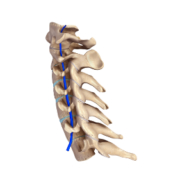
There are seven vertebrae that make up the cervical spine: C1 through C7. They protect the spinal cord and are part of the system that makes up the neck.

C1 is located at the base of the skull and C7 sits at the beginning of the thoracic spine. While C1 is the smallest vertebrae, each subsequent one is slightly larger as you move down the spine. This is necessary because the farther down the spine, the more weight it must bear.

The vertebrae C3 through C6 are called “typical vertebrae.” Like other vertebrae in the spine, they have a similar construction. The top vertebrae, C1 and C2 are “atypical vertebrae.” Their construction is somewhat different from typical vertebrae due to their specialized function and location.

The atlas, C1, is the only vertebrae that has more of a ring shape than a shape resembling a vertebra. It is what connects the skull to the spine and is responsible for about half of the head’s backward and forward range of motion.

The axis, C2, is the second vertebra and has a special construction that connects it to C1 at the atlanto-axial joint. It is responsible for around half of the head’s rotation. The vertebra prominens, C7, is much larger than the vertebrae that sit above it and its shape is different to facilitate its connection to T1, at the beginning of the thoracic spine.

Neck Pain

The cervical spine has several critical functions. It houses the spinal cord and protects it, supports the head and facilitates its movement, and facilitates the flow of blood to the brain.

The human head is around 10 to 13 pounds and the cervical spine, along with an intricate network of muscles, tendons, and ligaments support it. This is what also allow flexibility to the head so that it can move up and down, backwards and forwards, rotational, and side bending. This job alone puts a great deal of stress on the neck and can lead to neck pain. Common causes of neck pain include:

  • Whiplash (whipping the head forwards and then backwards very suddenly)
  • Degenerative disc disease
  • Pinched nerve
  • Age related conditions
  • Spinal stenosis
  • Sleeping in certain positions
  • Neck strain
  • Osteoarthritis
  • Keeping the neck in one position too long, such as looking down at a mobile device
  • Herniated disc
  • Neck injury
  • Fibromyalgia

Chiropractic Care for the Cervical Spine

A chiropractor will typically treat a patient with neck pain using cervical spinal manipulation, cervical spinal mobilization, or a combination of the two techniques. Cervical spinal manipulation is what most people think of regarding chiropractic treatment. It involves brief, quick thrusts that focus on a single joint at a time so that range of motion is returned to that area. Cervical spinal mobilization is a gentler, lower impact adjustment that does not use as much force but does move the joint to its correct position.

Other treatments the chiropractor may employ include the application of cold or heat, massage, and exercises to strengthen and stretch the neck. The doctor will carefully consider the patient, their lifestyle, habits, and current level of fitness then create a plan that is tailored specifically for them that will help them manage their pain and return flexibility and range of motion as quickly as possible.

Visit www.ocwc.ca for more health and wellness tips and information!

Cervical facet chiropractic benefits

What Chiropractic Patients Want to Know About Cervical Facet Joint Pain

October 21, 2019/0 Comments/in Chiropractic, Chiropractic Blog /by Dr. Kent Ferguson

Facet joint problems are among the most common sources of lower back and neck pain. They can cause debilitating, chronic problems with the neck and back and can lead to other more serious conditions and symptoms that can be disabling.

Cervical facet joint syndrome, or cervical facet osteoarthritis, is a degenerative condition marked by stiffness and pain in the cervical region (neck) of the spine. Patients are able to gain relief from various types of treatment, including chiropractic care.

What is Cervical Facet Joint Pain?

The spine is comprised of a chain of bones known as vertebrae. Each one has two facet joints on the back side and a large disc on the front side. This allows the vertebrae to stack neatly, one on top of the other, providing stabilization for the entire body.

The facet joints are synovial joints, like other joints in the body and sometimes they can become inflamed or injured, causing pain and stiffness. Cervical facet joint pain is, quite literally, a pain in the neck. It means that the joints in the neck area have become injured or inflamed. Pain from this condition can make it difficult for the patient to turn their head from side to side, or to move it up and down.

The cervical facet joints are almost always working. They undergo repetitive, constant motion and over time they can become torn or worn down. Problems within the joint can cause movement to be restricted or it can have too much movement, both of which can cause pain.

Injury, such as whiplash, to the area can also cause problems. If the condition is not treated appropriately, it can be degenerative and the patient can lose both flexibility and mobility, as well as suffer from chronic pain.

Symptoms of Cervical Facet Joint Pain

The symptoms of cervical facet joint pain tend to vary from patient to patient. A patient may experience one or several of these symptoms:

  • Tingling, weakness, or pain in the hand and arm
  • Neck pain
  • Upper back pain that can affect the shoulders
  • Pain between the shoulder blades
  • Headaches, typically located in the back of the head
  • Swelling and tenderness at the site of the inflamed facet joint
  • Decreased range of motion and flexibility in the neck

Treatment for Cervical Facet Joint Pain

When a patient is diagnosed with cervical facet joint pain the treatment is usually fairly conservative. Their doctor may recommend soft tissue massage, physical therapy, and posture correction. This is usually combined with medications such as an anti-inflammatory like ibuprofen, or muscle relaxers to ease muscle spasms in the muscles that surround the affected joint.

If those methods do not give the patient relief, the doctor may take a more aggressive approach, prescribing facet joint injections that use steroid medications injected into the affected joint. This approach is intended to keep the pain localized while reducing it. The procedure can be performed in an outpatient setting and has a good record of being effective, but the results are temporary.

Chiropractic for Cervical Facet Joint Pain

Chiropractors have had much success in treating cervical facet joint pain. They are able to manipulate the areas that are affected, restoring painful, restricted facet joints to a point where they are able to move much easier and without pain. Over time, with regular chiropractic treatments, they can help to reestablish a normal range of motion in the neck area for their patients. This is all done without any medications or injections. It is a natural, gently, effective method for relieving the pain and helping the patient enjoy a better quality of life.

Our clinic can be reached at (780)455-2112. Give us a call to schedule your chiropractic assessment and address any questions or concerns. We’re happy to help!

Book an Appointment

We respect your time and budget. Our appointments are efficient, flexible, and support a variety of payment options. Book an appointment for you or your family today by calling 780-455-2112.


Book online

Recent Blogs

  • Chronic Inflammation
  • How the Graston Technique Resolves Myofascial Pain
  • Ever Wonder: Why Does My Neck Hurt?
  • Acupuncture for Anxiety: A Natural Approach to Mental Well-Being
  • Perfect Posture

CONTACT US

10324 112 Street NW
Edmonton, AB T5K 1N1

1-780-455-2112
info@ocwc.ca

  • Facebook
  • Twitter
  • Youtube
  • Yelp

OFFICE HOURS

MONDAY – THURSDAY
8:00am – 6:00pm

FRIDAY
8:00am – 4:00pm

SATURDAYS & EVENINGS
By appointment only

SUNDAY
Closed

LEARN MORE

  • CHIROPRACTIC
  • MASSAGE
  • MANUAL LYMPHATIC DRAINAGE
  • ACUPUNCTURE
  • SHOCKWAVE THERAPY
  • FACIAL ACUPUNCTURE

RESOURCES

  • NEW PATIENTS
  • FAQ
  • PRIVACY POLICY
© Copyright - Oliver Chiropractic Wellness Clinic - powered by Enfold WordPress Theme
Scroll to top